The Day I Had to Break a Bride's Heart
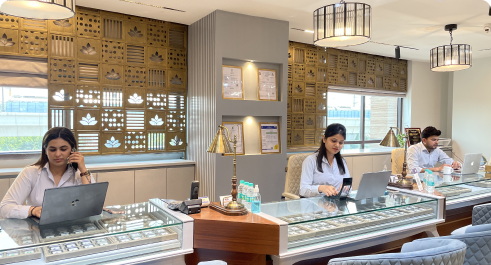
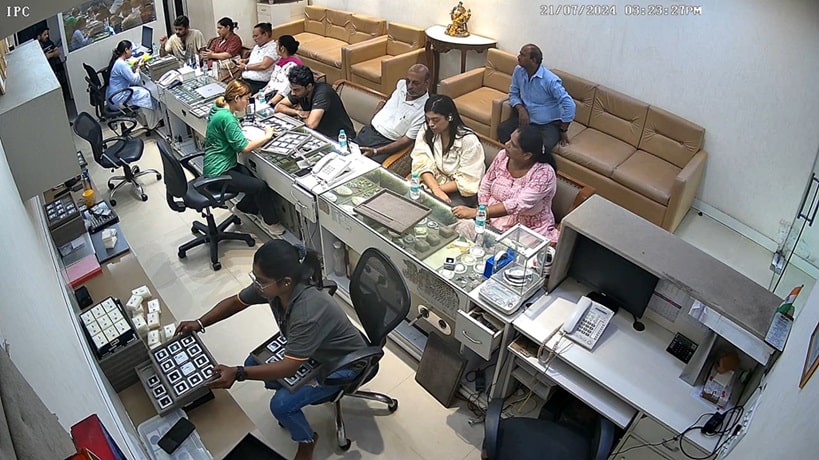
Last year, three days before her wedding, a bride-to-be came to our Defence Colony showroom near tears. She'd bought what she thought was a Basra pearl stone necklace for ₹85,000 from a "trusted family jeweler."
Her gut said something was wrong. She wanted me to verify it.
One touch against my teeth confirmed her fears: glass beads coated to look like pearls. Worth maybe ₹2,000. The "trusted" jeweler had vanished.
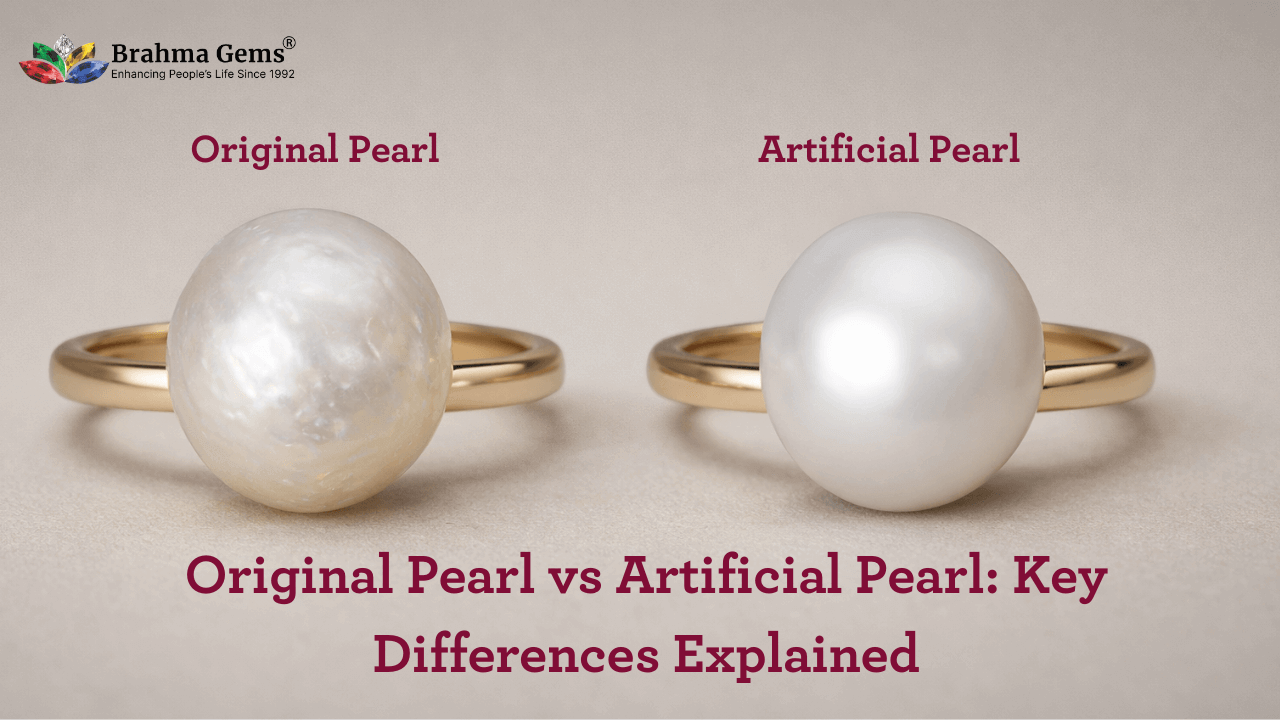
This is why understanding original pearl stone vs artificial pearl isn't just knowledge,it's financial self-defense.
How to Buy a Pearl Online? Expert Guide | Brahma Gems
The Brutal Truth About Natural Pearl Gemstone Availability
Let me start with reality: genuine natural pearl gemstones,those formed without human intervention,are nearly extinct commercially. When someone mentions Basra pearl stone, they're referencing Persian Gulf pearls that haven't been commercially harvested since the 1930s.
Real Basra pearls from pre-1930s stock exist in museum collections and royal treasuries. If someone's selling you "new" Basra pearl stone at any price, they're lying. It's physically impossible.
What does exist:
-
Cultured Pearls: Real pearls, human-initiated but naturally grown in oysters/mollusks
-
Artificial/Fake Pearls: Man-made objects with zero natural pearl formation
At Brahma Gems, 100% of our pearls are cultured,which are REAL pearls, just not "natural" in the wild-harvested sense. We're transparent about this because confusion in terminology causes most fraud.
What are the main origins of Pearl | Moti Origins | Brahma Gems
Understanding the Original Pearl Stone Reality
An original pearl stone means it formed inside a living mollusk with genuine nacre layers. This includes both wild-harvested (extremely rare) and cultured varieties.
Cultured pearls are formed identically to natural ones,nacre layers deposited around an irritant. The only difference: humans insert the initial irritant rather than nature. The resulting gem is chemically, physically, and optically identical.
I've personally sourced pearls from:
-
South Sea (Australia, Philippines): Large, luxurious, creamy white to golden
-
Tahitian (French Polynesia): Dark, mysterious blacks and peacock greens
-
Akoya (Japan, China): Classic white pearls with rose overtone
-
Freshwater (China): Affordable, varied shapes and colors
Each origin has distinct characteristics. Understanding these prevents the common trap of buying Chinese freshwater pearls marketed as expensive South Sea varieties.
How to Select and Buy Pearl (Moti) || Brahma Gems
The 5-Second Test: How to Spot Artificial Pearls
After examining 10,000+ pearls over 14 years, I can identify fakes in seconds. Here's how:
-
The Tooth Test (sounds weird, works perfectly)
Gently rub the pearl against your front teeth. An original moti stone feels slightly gritty or sandy,like fine sandpaper. Artificial pearls feel smooth as glass.
This works because real pearls have microscopic nacre platelets creating texture. Fake pearls are just smooth coated beads.
I've used this test in front of shocked clients hundreds of times. It's 95% accurate.
-
The Temperature Test
Real natural pearl gemstones feel cool when first touched, then warm to body temperature. Plastic fakes feel room temperature immediately. Glass fakes also feel cool initially (so combine with tooth test).
-
The Visual Perfection Test
This is counterintuitive but crucial: If every pearl in a strand looks IDENTICAL,perfectly round, perfectly colored, perfectly sized,they're fake.
Real pearls show subtle variations. Each formed in different organisms under different conditions. Perfect uniformity screams artificial.
Last month, a customer insisted his pearls were real because they looked so perfect. That perfection proved they weren't.
What are different types of pearls || Brahma Gems
Why Buy Pearl Online Requires Extra Caution
Brahma Gems offers online pearl sales, so I'm not anti-digital. But when you buy pearl online, you can't do the tooth test or feel the weight. This makes you vulnerable.
Red flags when shopping online:
-
"Natural Basra Pearl" Listings: Instant fraud. Real Basra pearl stones are museum pieces, not e-commerce items.
-
Too-Perfect Photos: Real pearls show subtle surface irregularities. Overly perfect photos hide artificial origins.
-
Unrealistic Pricing: A 10mm South Sea pearl strand costs ₹80,000-₹3,00,000. Anyone selling for ₹15,000 is selling fakes or severely damaged goods.
-
No Origin Documentation: Reputable sellers specify origin (South Sea, Akoya, Tahitian, freshwater). Vague "pearl necklace" descriptions hide low quality or fakes.
-
No Return Policy: If they won't accept returns after gemological verification, they're selling fakes.
At Brahma Gems, every online pearl purchase includes:
-
Detailed origin documentation
-
High-resolution photos showing actual texture
-
7-day verification return policy
-
Certificate of authenticity
We WANT clients to verify. Confidence comes from transparency.
The Buy Venezuela Pearl Marketing Trap
"Venezuela pearl" is marketing language. Venezuela doesn't produce significant commercial pearls. When sellers use exotic-sounding origins without documentation, they're creating confusion to hide low quality or fakes.
If someone mentions buy Venezuela pearl without providing specific farm information, verification certificates, or allowing independent gemological testing,walk away. It's probably Chinese freshwater pearls with fancy branding.
Legitimate pearl dealers specify exactly: "Japanese Akoya from Ago Bay" or "Australian South Sea from Broome." Precision indicates legitimacy.
Why 90% of people are not getting desired results from Pearl | Brahma Gems
What You're Actually Getting When You Buy Gemstone Online from Brahma Gems
I've spent 14 years building Brahma Gems' reputation. Our pearl selection process:
1. Direct Source Relationships: We buy directly from South Sea farms in Australia, Akoya producers in Japan, and verified freshwater facilities in China. No middle dealers = no opportunity for fake insertion.
2. In-House Gemologist Verification: Every pearl passing through our facility gets examined by our GIA-trained gemologists. We reject 30% of what we're offered because it doesn't meet standards.
3. Transparent Grading: We explain exactly what grade you're buying,luster quality, surface cleanliness, shape category, size. No marketing fluff, just facts.
4. Certification: Pearls above ₹10,000 include gemological lab certification. You're not taking our word,you're getting independent verification.
5. Education: We WANT clients educated. Informed customers make better decisions and don't return products because reality matched their expectations.
Why Transparency Matters at Brahma Gems
After 14 years, our reputation is everything. When astrologers, jewelry designers, and collectors recommend clients to us, they're vouching for our integrity.
We could sell artificial pearls as real and make quick money. But one fraud destroys a decade of reputation building.
Every original pearl stone we sell meets our personal standards. If I wouldn't buy it, we won't sell it.
Visit our showrooms. Handle pearls personally. Do the tooth test yourself. Compare our quality to competitors. Ask hard questions.
Informed customers who understand natural pearl gemstone value become lifelong clients. That's worth more than any single transaction.
FAQs
Q1: Can the tooth test damage my pearl jewelry?
No, gently rubbing pearls on teeth creates no damage. Pearls rank 2.5-4.5 on Mohs hardness scale, while tooth enamel is around 5. The pressure used for testing is too light to cause wear. We've done this test thousands of times without issue.
Q2: Are all affordable pearls fake?
No. Freshwater cultured pearls (₹2,000-₹8,000 for decent quality strand) are real pearls, just less rare than South Sea or Akoya. They're genuine nacre-layered gems, simply from more abundant sources. Affordable doesn't mean fake,extremely cheap (under ₹1,000 for strand) usually does.
Q3: Can I still get astrological benefits from cultured pearls versus natural wild pearls?
Yes, according to most Vedic astrologers we consult with. The chemical composition and structure are identical. The pearl formed in a living organism with genuine nacre layers,the astrological energy comes from that natural formation process, not from whether humans initiated it.
 +919953660004
 +18886144437
 +44
8081965700
+44
8081965700